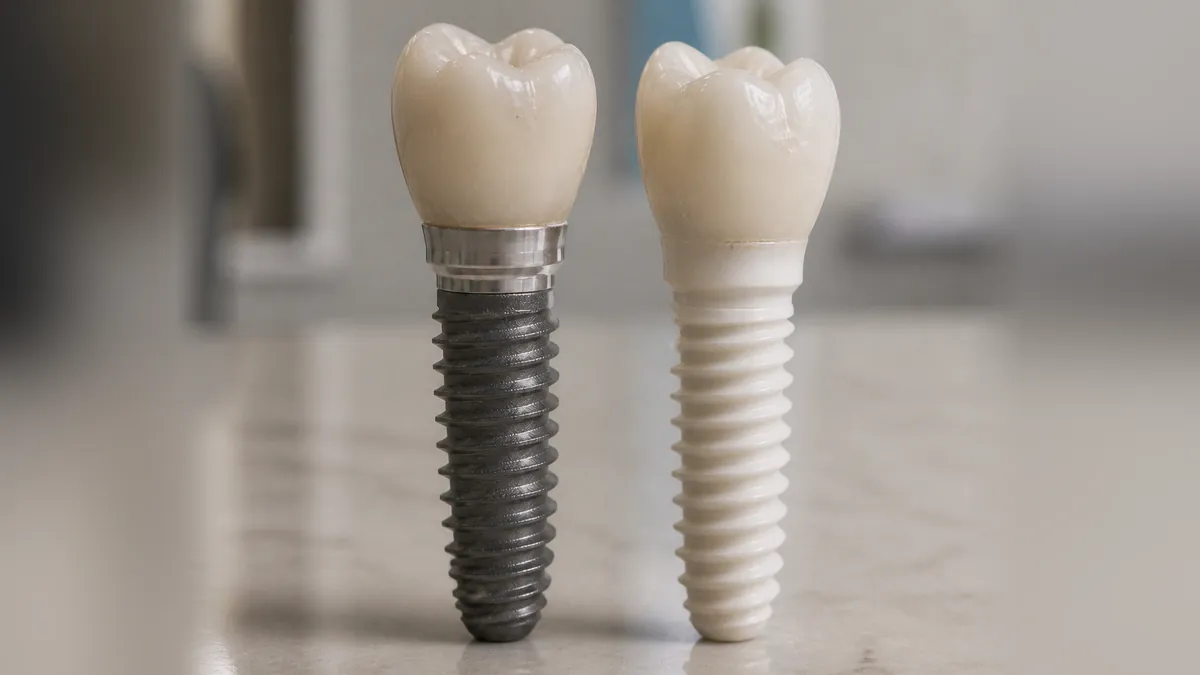
Most people researching implants spend their time on cost, pain, and recovery. The material question tends to come up late, usually when a dentist mentions that ceramic is an alternative to titanium dental implants and the patient wonders whether they’ve been missing something.
For a long time there wasn’t much to decide. Nearly every implant was titanium. Ceramic implants made from zirconia have become more common, and they do some things better. They also come with tradeoffs that get less attention than they deserve.
What the Implant Actually Does
The implant itself is a small post that sits in the jawbone where the tooth root used to be. Over a few months, bone grows tightly against its surface, a process called osseointegration. After that, a connector (the abutment) goes on top, and then the crown you’ll see in the mirror.
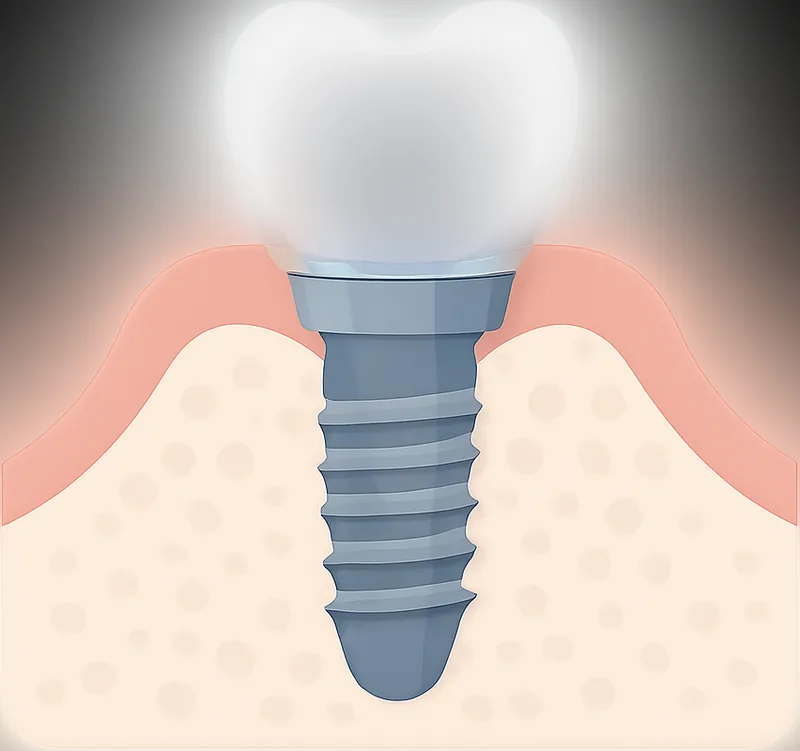
The material you pick affects three things: how the post bonds with bone, whether it shows through the gums, and how much room your dentist has to adjust the angle of the final tooth.
Titanium Dental Implants: Decades of Data
Titanium dental implants have been placed since the 1960s, so there’s a large body of long-term research on how they hold up. Bone bonds well to titanium, and the metal tolerates heavy chewing without cracking.
Most titanium systems come in two pieces, with the post and abutment as separate parts. That matters more than it sounds. If the bone isn’t perfectly positioned, a two-piece design lets the dentist correct the angle so the crown lines up with your other teeth.
The weak spot is cosmetic. When gum tissue is thin, a faint gray shadow can show near the gum line. On a back molar nobody notices. On a front tooth, some patients do.
Ceramic Dental Implants: The Metal-Free Choice
Zirconia is white, so there’s nothing gray to show through. That’s the main reason dentists suggest it for front teeth and for patients with thin gums. It’s also the obvious fit for anyone who wants no metal in their mouth.
The research is promising but younger. A 2023 systematic review in Clinical Oral Investigations found survival rates for zirconia and titanium implants were similar over the short term. Zirconia also scored better on the appearance of the surrounding gum tissue. The authors were clear that longer trials are still needed. A 2024 meta-analysis in the Journal of Clinical Medicine leaned the other way, reporting better one-year survival and less bone loss with titanium.
Design is the other consideration. Many zirconia implants are one-piece, with the post and abutment as a single unit. Once it’s placed, the angle is set, so planning beforehand has to be precise.
Side-by-Side Comparison
| Factor | Titanium | Ceramic (Zirconia) |
|---|---|---|
| Research history | Several decades of long-term data | Encouraging short-term data, fewer long-term trials |
| Strength | Very strong, resistant to fracture | Hard and wear-resistant, less forgiving under some stresses |
| Look near the gum line | Can show a gray tint through thin gums | Tooth-colored |
| Metal content | Contains metal | Metal-free |
| Design | Usually two-piece, adjustable | Often one-piece, angle fixed at placement |
| Typical fit | Most cases, including back teeth and full-arch work | Front teeth, thin gums, metal-free preference |
Who Each One Tends to Suit
Titanium dental implants are usually the practical pick for molars, where chewing force is highest. They’re also the more common choice for patients getting several implants or a full arch, and for cases where limited bone means the dentist needs room to adjust.
Zirconia makes the most sense for a single front tooth, particularly when the gums are thin. It also suits people with a known metal sensitivity, provided their bite and bone support are a good match.
Two things affect both materials equally. Heavy grinding stresses any implant, and a night guard is often part of the plan. Active gum disease has to be treated first, because infection around an implant damages the bone regardless of what the post is made of.
What About Titanium Allergies?
You may have read that titanium causes allergic reactions. Confirmed titanium allergy appears to be uncommon, and most people tolerate it without problems. If you’ve reacted to metal jewelry or other implants before, bring it up at your consultation. Your dentist may suggest testing or simply recommend zirconia.
Making the Call With Your Dentist
A good recommendation comes after an exam and 3D imaging. Your dentist should check bone height and width, gum thickness, your bite, and where the missing tooth sits.
It helps to see a practice that offers more than one implant type, since the advice is less likely to be shaped by what they happen to stock. For an example of how a practice lays out these choices, you can review the dental implant options at Henry Smiles Dental, which include both titanium and zirconia.
Questions worth asking at the consultation:
- Which material do you recommend for this tooth, and why?
- How thin are my gums here, and will that affect how it looks?
- Is this a one-piece or two-piece implant?
- Does my grinding or bite change your recommendation?
- What will maintenance look like over the years?
Pay attention to how the dentist answers. Someone who explains the downsides of their own recommendation is giving you more useful information than someone who calls one material best for everyone.
Keeping It Healthy
Implants don’t get cavities, but the gum and bone around them can still become inflamed. The more serious form, peri-implantitis, involves bone loss and is a leading reason implants run into trouble years after placement. An international consensus report on implant maintenance found that patients who kept up with recommended maintenance visits had fewer cases of it.
The routine is familiar. Brush twice a day with a soft brush, clean between your teeth every day, and don’t skip professional cleanings. If you grind, wear the night guard. If you smoke, cutting back helps healing and lowers the odds of complications.
Frequently Asked Questions
Is ceramic better than titanium?
Not across the board. Titanium has longer research behind it and more design flexibility. Zirconia avoids metal and can look more natural near thin gums. Which is better depends on the tooth and the person.
Do zirconia implants last as long as titanium dental implants?
Short-term results are similar in several studies, but titanium has decades more long-term data. With good care, both are meant to last many years.
Can I switch materials later?
Not easily. Removing an integrated implant usually means rebuilding bone before placing a new one, so it’s worth getting the choice right the first time.
Do implants cause problems with MRIs or X-rays?
They can distort images. The FDA advises patients to tell their providers and imaging technicians about dental implants before an MRI or X-ray.
Can anyone get a ceramic implant?
No. Bone support, bite force, and