Your dentist says you need a deep teeth cleaning, and somewhere on the drive home through Houston traffic a question forms: do I actually need this, or am I being sold something?
That’s a fair question, and it deserves a straight answer instead of a sales pitch. Here’s the honest version. Some people absolutely need a deep cleaning, and skipping it costs them bone and eventually teeth. Others hear they need one when a regular cleaning would do the job. The difference between the two isn’t a matter of opinion. It comes down to measurements your dentist can show you on a chart.
This article explains what those measurements mean, when scaling and root planing genuinely makes sense, and when it doesn’t — so you can walk into your next appointment knowing what to ask.
What a Deep Teeth Cleaning Actually Is
A deep cleaning (the clinical name is scaling and root planing, or SRP) is not a more thorough version of your regular six-month cleaning. It’s a different procedure treating a different problem.
A regular cleaning (a prophylaxis) removes plaque and tartar from the visible surfaces of your teeth and just below the gumline. It’s maintenance for healthy gums.
Scaling and root planing goes below the gumline to clean the root surfaces themselves. Scaling removes the hardened tartar and bacterial deposits clinging to the roots. Root planing smooths those root surfaces so gum tissue can heal back against the tooth and bacteria have a harder time recolonizing. It treats active gum disease — specifically periodontitis, where infection has started to separate the gum from the tooth and erode the bone underneath.
That distinction matters, because it’s also the test for whether you need one.
The Numbers That Decide It: Pocket Depths
At a proper exam, your dentist or hygienist takes a small measuring probe and records the depth of the space between your gums and each tooth, usually six measurements per tooth. This is periodontal charting, and it’s the evidence a deep cleaning recommendation should rest on.
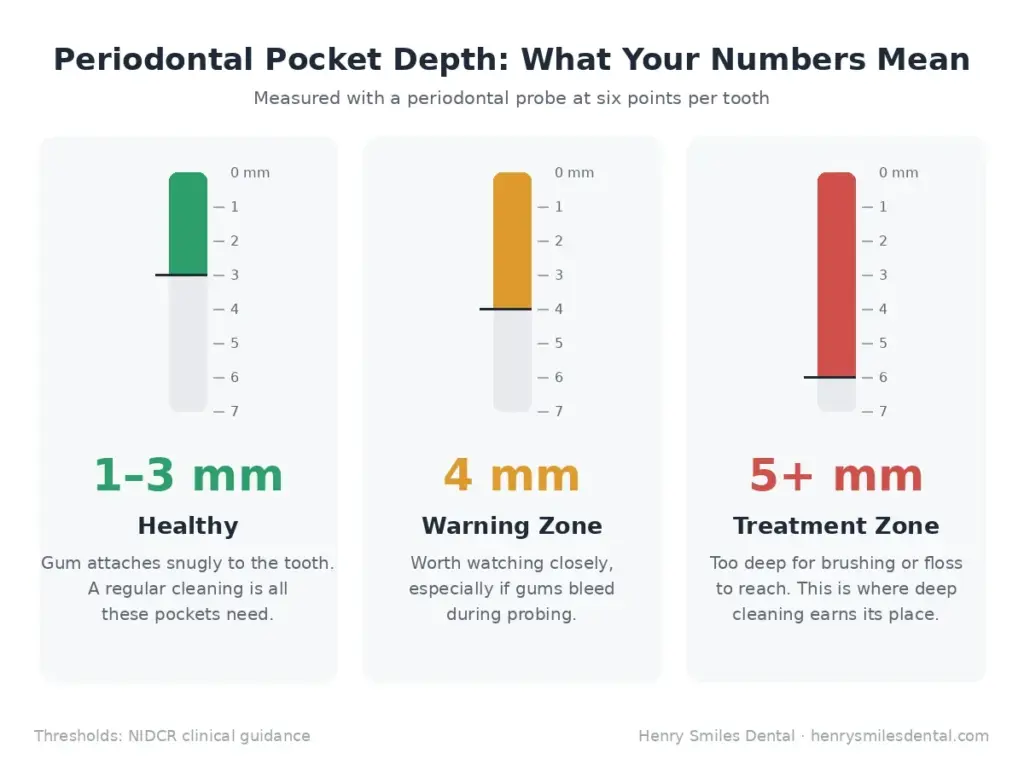
Here’s how to read your own numbers:
- 1–3 mm: Healthy. The gum hugs the tooth the way it should. These pockets do not need scaling and root planing.
- 4 mm: A warning sign, especially if the gums bleed during the measurement. This is the gray zone where your dentist should explain their reasoning, not just hand you a treatment plan.
- 5 mm and deeper: At this depth, your toothbrush and floss physically cannot reach the bottom of the pocket. Bacteria and tartar sit on the root undisturbed, and a regular cleaning can’t remove them either. This is where scaling and root planing earns its place.
We didn’t invent these thresholds. They come straight from the NIDCR’s overview of periodontal disease, which covers the full picture of how gum disease progresses.
Pocket depth isn’t the only evidence. Bleeding during probing, tartar below the gumline on your X-rays, and bone loss on those same X-rays all point the same direction. When several of those show up together, nobody is upselling you. Scaling and root planing is the standard first-line treatment for periodontitis, and it can stop the disease before it costs you teeth.
When a Regular Cleaning Is Enough
Now the part most dental blogs won’t say plainly: if your pockets measure 1–3 mm, your gums don’t bleed, and your X-rays show no bone loss, a full-mouth deep cleaning is overtreatment. You don’t need it, and a practice recommending one anyway should be able to show you the measurements that justify it.
A few situations that do not by themselves justify scaling and root planing:
- You haven’t had a cleaning in a while, but your gums are healthy
- You have some staining or visible tartar above the gumline
- You’re a new patient at an office that recommends deep cleanings “as a baseline”
If a Houston dental office recommends a deep teeth cleaning before anyone measures your pockets or takes X-rays, ask for the charting first. A legitimate recommendation survives that question easily.
There’s also a middle ground worth knowing about. Gingivitis, which is inflammation without bone loss, is reversible, and a thorough regular cleaning plus better home care often resolves it. Not every case of bleeding gums means periodontitis.
How We Approach Deep Teeth Cleaning at Our Houston Office
At Henry Smiles Dental, a recommendation for deep teeth cleaning in Houston starts the same way this article does: with full periodontal charting and X-rays, which we review with you before scheduling anything. If your numbers don’t support treatment, we’ll tell you that too.
When the numbers call for it, the visit itself is more comfortable than most patients expect. We numb the area first and typically work in sections, often half the mouth or one quadrant per visit, so no single appointment feels overwhelming. Depending on your case, we may use traditional scaling and root planing, laser-assisted periodontal therapy, or a combination of both. The right approach depends on pocket depths, the amount of buildup, and how your tissue responds.
Afterward, your gums need a chance to heal and reattach, and you’ll typically move to periodontal maintenance visits every three to four months instead of the standard six. Three to four months is roughly how long bacteria take to reorganize below the gumline, and staying ahead of them protects the result.
Untreated periodontitis is also the most common driver of gum recession, which is why this treatment and our gum recession treatment work go hand in hand. Managing the infection first makes any recession repair worth doing. You can read more about our full range of periodontal care in Houston on our service page.
Questions to Ask Before You Say Yes
Whether it’s our office or any other, these five questions will tell you quickly whether a deep cleaning recommendation is solid:
- What are my pocket depths, and can I see the chart?
- Do my X-rays show bone loss or tartar below the gumline?
- Did my gums bleed during probing?
- Why this instead of a regular cleaning?
- What happens if we wait six months and re-measure?
A good clinician welcomes these questions, because the answers sit right there in your chart. Hesitation to show you the numbers tells you something too.
Frequently Asked Questions
Does a deep teeth cleaning hurt?
We numb the treated area first, so the procedure itself shouldn’t hurt. Expect some tenderness and gum sensitivity for a few days afterward, usually manageable with over-the-counter pain relief and a soft diet.
How long does a deep teeth cleaning take?
Plan on roughly 45 minutes to an hour per visit, and most patients finish in one or two appointments depending on how many areas need work.
Can my gums reattach after scaling and root planing?
Yes — that’s the goal. Once the root surfaces are clean and smooth, gum tissue can heal snugly against the tooth and pocket depths often shrink. Your dentist will re-measure at a follow-up visit to confirm the treatment worked.
What happens if I skip a deep cleaning I actually need?
Periodontitis doesn’t resolve on its own. Pockets deepen, bone loss continues, gums recede, and teeth eventually loosen. It’s also a disease where earlier treatment is simpler treatment: what a deep cleaning handles today can require surgery later.
Is a deep cleaning ever done in one visit?
Sometimes, for milder or more localized cases. We split more involved cases into multiple visits so each section gets thorough attention while you stay comfortable.
Wondering Whether You Actually Need One?
If someone told you that you need a deep teeth cleaning in Houston and you’re not sure, we’re happy to be the second opinion. We’ll measure, show you the chart, and give you a straight answer — including “you don’t need it,” if that’s what the numbers say. Call Henry Smiles Dental at (713) 532-9171 or request an appointment online.
Prefer getting your dental health information from us? Add Henry Smiles Dental as a preferred source on Google using the button above.